What Is the Principle Behind Go's GMP Scheduler
Disclaimer: I look down on technical topics like “What is the principle behind Go’s GMP scheduler?”
I’m usually not interested in studying this type of question. But it’s been asked so frequently in interviews that I’m now setting aside 2 hours to understand it. On one hand, I want to see if there’s any real technical depth behind it; on the other hand, I’m writing down the answer here. But I won’t let this information stay in my brain—next time I’m asked in an interview, I’ll still say I don’t know 😏
Basic Concepts
GMP is an acronym:
- G (Goroutine): A coroutine; every
gostatement adds a new G. - M (Machine): A system-level thread, similar to a thread in other languages.
- P (Processor): The number of P equals
GOMAXPROCS, typically the number of CPU cores.
GMP means: spin up several M (threads) to execute G (goroutines), but at most P (cores) M’s can run in parallel.
Three Invariants
Here come some boring (and simplified) rules:
- Only M’s that obtain a P can execute tasks.
- Runnable G’s reside in either a P’s local run queue or the global queue.
- When an M becomes blocked (syscall/cgo), it promptly hands over its P.
These may sound confusing now, but they’ll make more sense with the code examples later.
GMP Debug Log
Here’s a basic code file to demonstrate spawning a goroutine:
package main

import (
    "fmt"
    "sync"
)

func main() {
    var wg sync.WaitGroup
    wg.Add(1)
    go func() {
        defer wg.Done()
        fmt.Println("Hello from goroutine")
    }()
    wg.Wait()
}
Run it with debug flags:
go build demo0.go
GODEBUG='schedtrace=200,scheddetail=1' ./demo0
Don’t use go run—it introduces extra runtime logs. The binary version’s logs are cleaner:
SCHED 0ms: gomaxprocs=10 idleprocs=7 threads=5 spinningthreads=1 needspinning=0 idlethreads=0 runqueue=0 gcwaiting=false nmidlelocked=1 stopwait=0 sysmonwait=false
  P0: status=0 schedtick=0 syscalltick=0 m=nil runqsize=0 gfreecnt=0 timerslen=0
  P1: status=1 schedtick=0 syscalltick=0 m=2 runqsize=0 gfreecnt=0 timerslen=0
  ...
Hello from goroutine
These logs show:
- The first line starting with
SCHEDis a summary—10 P’s were launched (gomaxprocs=10). - Only
P1is running, held byM2. P0is held byM3and is inspinningstate (waiting for tasks).
You don’t see the print-related G because it finishes too quickly—GMP details can be viewed via debug logs like this.
Preemptive Scheduling
package main

import (
    "fmt"
    "runtime"
    "time"
)

func busy(tag string, d time.Duration) {
    end := time.Now().Add(d)
    x := 0
    for time.Now().Before(end) {
        x++
    }
    fmt.Println(tag, "done", x)
}

func main() {
    runtime.GOMAXPROCS(1)
    go busy("A", 1500*time.Millisecond)
    busy("B", 1500*time.Millisecond)
}
Sometimes “A” prints first, sometimes “B”.
We set GOMAXPROCS(1), so only one P exists. Yet, Go’s GMP scheduler preempts every 10ms, meaning even if go busy("A") is running, it eventually yields, letting the main thread run B.
To visualize this more clearly:
func busy(tag string, d time.Duration) {
    end := time.Now().Add(d)
    next := time.Now()
    for time.Now().Before(end) {
        if time.Now().After(next) {
            fmt.Print(tag, " ") // Print ~every 100ms
            next = time.Now().Add(100 * time.Millisecond)
        }
    }
    fmt.Println(tag, "done")
}
Sample output: B A B A B A A B A B A B A B A B A B A B A B A B B A B A B A B done
This confirms that A and B alternate—they’re interleaved due to GMP’s preemptive scheduler.
P Work Stealing
package main

import (
    "runtime"
    "sync"
    "time"
)

func spin(d time.Duration) {
    deadline := time.Now().Add(d)
    for time.Now().Before(deadline) {
    }
}

func main() {
    runtime.GOMAXPROCS(1)

    const N = 120
    var wg sync.WaitGroup
    wg.Add(N)
    for i := 0; i < N; i++ {
        go func() { defer wg.Done(); spin(500 * time.Millisecond) }()
    }

    time.Sleep(30 * time.Millisecond)

    runtime.GOMAXPROCS(4)
    wg.Wait()
}
Initially all G’s go to one P. Then GOMAXPROCS is increased to 4—new P’s (P1–P3) “steal” tasks from P0’s queue.
Debug logs show:
P0: runqsize=17
P1: runqsize=5
P2: runqsize=5
P3: runqsize=17
Initially, all G’s were with P0. Later, others came and took some.
P’s runq and the Global Queue
package main

import (
    "runtime"
    "sync"
    "time"
)

func spin(d time.Duration) {
    end := time.Now().Add(d)
    for time.Now().Before(end) {
    }
}

func main() {
    runtime.GOMAXPROCS(1)

    const N = 600
    var wg sync.WaitGroup
    wg.Add(N)
    for i := 0; i < N; i++ {
        go func() { defer wg.Done(); spin(800 * time.Millisecond) }()
    }

    time.Sleep(500 * time.Millisecond)

    runtime.GOMAXPROCS(4)
    wg.Wait()
}
Use debug to analyze:
go build demo4.go
GODEBUG='schedtrace=200,scheddetail=1' ./demo4 &> demo4.log
The first few lines of the log look like this:
SCHED 0ms: gomaxprocs=10 idleprocs=9 threads=2 spinningthreads=0 needspinning=0 idlethreads=0 runqueue=0 gcwaiting=false nmidlelocked=0 stopwait=0 sysmonwait=false
  P0: status=1 schedtick=0 syscalltick=0 m=0 runqsize=0 gfreecnt=0 timerslen=0
  P1: status=0 schedtick=0 syscalltick=0 m=nil runqsize=0 gfreecnt=0 timerslen=0
The runqueue=0 on the first line is the global queue. The runqsize=0 after P0 is P0’s local queue, and the one after P1 is P1’s local queue. At this point P1 has status 0, meaning it is not runnable.
As the program runs, P0 starts a large number of Gs. The log then looks like this:
SCHED 200ms: gomaxprocs=1 idleprocs=0 threads=5 spinningthreads=0 needspinning=1 idlethreads=3 runqueue=395 gcwaiting=false nmidlelocked=0 stopwait=0 sysmonwait=false
  P0: status=1 schedtick=10 syscalltick=2 m=0 runqsize=204 gfreecnt=0 timerslen=1
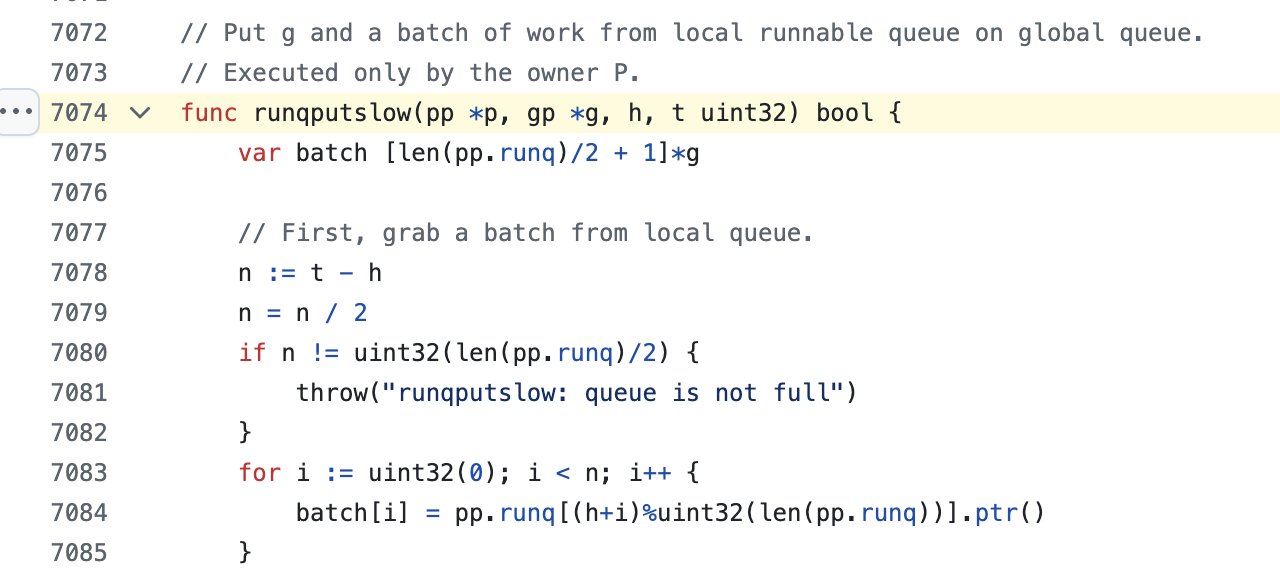
The default upper limit for a P’s local queue is 256. Once it reaches that limit, excess tasks spill into the global queue.
P1, P2, and P3 then start and take tasks from the global queue. When work is available globally, they do not need to steal from another P:
SCHED 826ms: gomaxprocs=4 idleprocs=0 threads=5 spinningthreads=0 needspinning=1 idlethreads=0 runqueue=217 gcwaiting=false nmidlelocked=0 stopwait=0 sysmonwait=false
  P0: status=1 schedtick=35 syscalltick=2 m=0 runqsize=179 gfreecnt=0 timerslen=0
  P1: status=1 schedtick=14 syscalltick=0 m=3 runqsize=90 gfreecnt=0 timerslen=0
  P2: status=1 schedtick=14 syscalltick=0 m=4 runqsize=64 gfreecnt=0 timerslen=0
  P3: status=1 schedtick=13 syscalltick=0 m=2 runqsize=46 gfreecnt=0 timerslen=0
If a P cannot find work in its local runq, the global queue, or another P, it checks netpoll to ask the operating system whether a new G is available. If so, it runs that G; otherwise, it spins while waiting. This is the logic a P follows when looking for work.
Blocking syscalls Yield P
package main

import (
    "fmt"
    "runtime"
    "time"
)

func main() {
    runtime.GOMAXPROCS(2)

    go func() {
        time.Sleep(2 * time.Second)
        fmt.Println("blocking done")
    }()

    go func() {
        for i := 0; i < 6; i++ {
            time.Sleep(300 * time.Millisecond)
            fmt.Println("still running", i)
        }
    }()

    time.Sleep(3 * time.Second)
}
Output:
still running 0
still running 1
still running 2
still running 3
still running 4
still running 5
blocking done
Although the first G appears to occupy a P while blocking, the second G continues to run.
This shows that the GMP scheduler does not let one blocked G prevent other Gs from executing. In fact, that is a basic requirement for a coroutine scheduler.
Disable Async Preemption
package main

import (
    "fmt"
    "runtime"
    "time"
)

func spin() {
    for { }
}

func main() {
    runtime.GOMAXPROCS(1)
    go spin()
    time.Sleep(100 * time.Millisecond)
    fmt.Println("I should still print unless preemption is off")
}
Two ways to run:
go build demo7.go
GODEBUG='schedtrace=1000,scheddetail=1' ./demo7
and:
go build demo7.go
GODEBUG='schedtrace=1000,scheddetail=1,asyncpreemptoff=1' ./demo7
The asyncpreemptoff=1 setting disables asynchronous preemption. Without it, the program runs normally and prints:
I should still print unless preemption is off
With asynchronous preemption disabled, the infinite loop blocks the program. This example highlights GMP’s ability to yield the CPU proactively: when that ability is disabled, GMP gets stuck.
Go Source Code
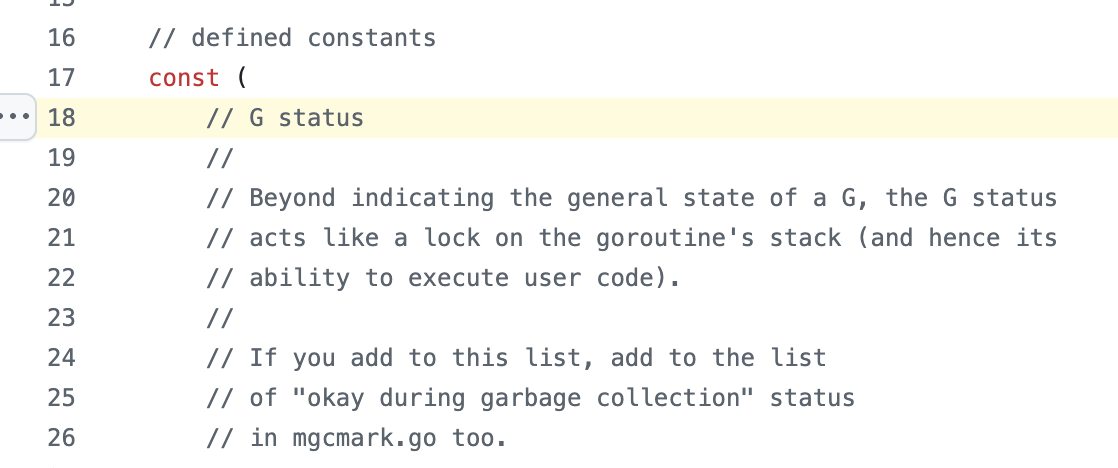
I didn’t dig deeply into the source. For example, constants for G/M/P are in src/runtime/runtime2.go:
And runqputslow in src/runtime/proc.go handles queue overflow:
Digging Deeper
This post is probably incomplete—I’m not going any deeper. Some people may love diving into this.
GMP is an engineering implementation of a coroutine scheduler. Many care about the engineering details—task queue management, preemption, yielding, etc. But underneath, all coroutine schedulers are based on continuation. Go just happens to spotlight coroutines. Other languages can implement their own coroutine schedulers too.
So here’s the question: if you love researching GMP, have you studied coroutine/virtual thread/async function/process implementations in other languages? How do they differ from Go’s goroutines?
If my job someday requires a deep understanding of these, I’ll learn them.
Doubts
I once said:
Go designed automatic garbage collection to reduce the mental load of memory management. Yet some interviewers go out of their way to master GC internals and quiz candidates on it. If you truly believe in using your brain to manage memory, why not just use Rust?
It’s like I’m learning to drive, and someone expects me to understand how internal combustion works before getting a license. I’m not building cars—I’m driving one.
Same goes for Go’s go keyword. It was built to make concurrency easy. Yet some folks study its internals obsessively, and use that as a gauge of Go proficiency. Doesn’t that contradict the language’s intent? If a language needs you to understand scheduling internals to write good code, it has failed in its abstraction.
If you’re building programming languages or implementing schedulers, by all means, understand GMP thoroughly. Otherwise?